

WHAT THE MIGHTY DUCKS KNOW THAT WE DON'T
By Jessica Breazeale
Most evenings, you can find me outside, chair tilted back, eyes on the sky. It's my place of peace — the one part of the day where nothing is asking anything of me. And almost every evening, around the same time, the same thing happens: a line of what looks like ducks flies overhead in a perfect V.
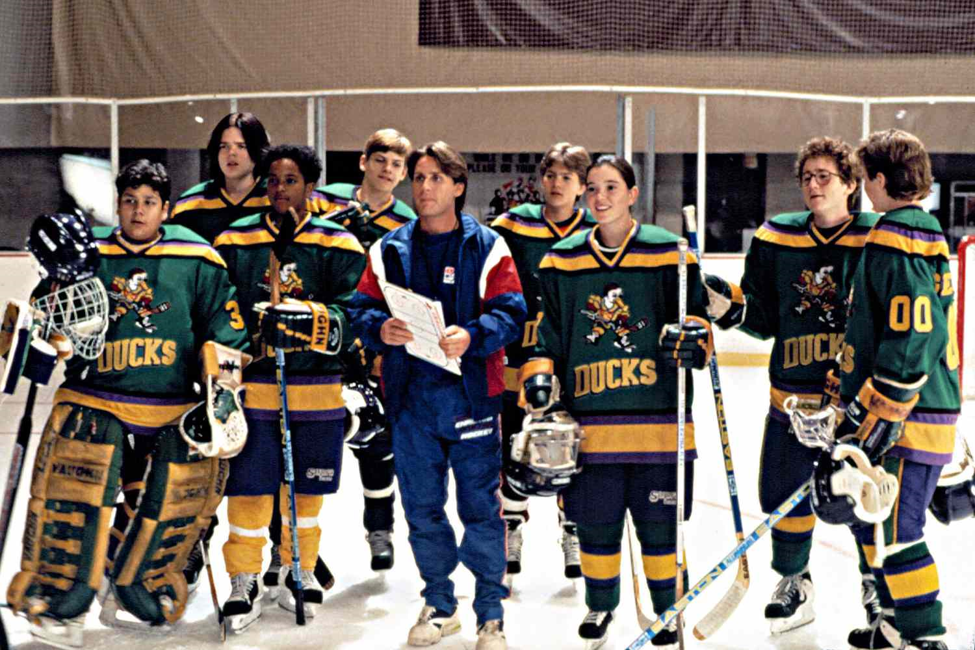
Every single time, without fail, my brain does the same thing — it flashes straight back to childhood, to The Mighty Ducks, Emilio Estevez wrangling a rag-tag pee-wee hockey team into a flying V on the ice. (If you know, you know.) The newer, reimagined Mighty Ducks show is worth a watch, too.
So one evening, watching the real thing overhead instead of the movie version, I finally went down the rabbit hole: why do ducks fly in a perfect V?
Turns out, the science is fascinating on its own. But the more I read, the more it became something bigger than science to me.
The Science, Quickly

Birds flying in formation aren't just showing off. A few things are going on:
● They're drafting off each other. Every flap of a wing creates a little upward current of air trailing behind it. The bird flying slightly behind and to the side catches that lift, which means less work to stay airborne — like drafting behind a cyclist.
● They can actually see each other. The V keeps every bird in view of its neighbors instead of staring at the tail feathers in front of it, which makes it easier to stay coordinated over long distances.
● Nobody stays up front forever. The lead bird gets none of that drafting benefit — it's cutting the wind for everyone else. So they rotate. The hardest position gets passed around instead of parked on one bird.
That last one is where this stopped being a science lesson and started being a sermon.
Taking Turns Bearing the Hardest Part
Here's what stopped me in my tracks: these birds — with brains the size of a walnut — have figured out something we still haven't. They can apparently sense when a member of the flock is carrying too much, and something in them says go take the load off.
I've spent eighteen years in ministry. And if there's one pattern I've watched play out over and over, it's pastors doing all the heavy lifting until there's nothing left of them. Nobody rotates in. Nobody says “let me take the front for a while.” We just watch good people burn all the way out, because somewhere along the way we decided the leader carries it alone.
Watching a flock of ducks figure out load-sharing instinctively, while I've watched congregation after congregation fail to do it on purpose, is a little humbling. It's also strangely hopeful — if a duck can feel the weight of another duck and move to cover it, surely we can get there too.
It's Only “Perfect” From Where I'm Sitting

Here's the twist, though. From my chair, looking up, that formation looks flawless. Clean lines, perfect symmetry, like something drawn with a ruler.
But it's not. Up close, it's lopsided — one arm of the V almost always longer than the other, birds shifting in and out, adjusting constantly. It only looks perfect because I'm seeing it from three hundred feet below and it's moving fast.
That felt a little too familiar too. How many things — churches, families, ministries — look like a perfect V from a distance, when up close it's really just a group of tired creatures doing their best to hold a shape together? Maybe that's not a flaw. Maybe that's just what real community looks like when you're close enough to see it clearly. It's all about perspective.
What Happens When We Clip the Wings
There's another side worth pondering. People sometimes take a beautiful winged creature like this and try to make it their pet — clip the wings, keep it close, tame the very thing built to fly in formation with a hundred others. I get the instinct. Something is appealing about keeping a beautiful, wild creature safe in a pen, all to yourself.
But clip the wings and you don't just take away the flight — you take away the V. A bird built to rotate through the lead, to draft off its neighbors, to read exhaustion in the one beside it, doesn't get stronger in isolation. It just gets smaller.
We do this to people too — keep them close, call it protection, and wonder later why they never learned to soar. I can count too many times people who have attempted to clip my wings. It never worked out well. Some creatures are just meant for flight!
So What's the Bigger Picture?
It's this: even migratory birds can sense heaviness and exhaustion in one another, and something in them moves to take a turn so no one carries more than their share.
Somewhere along the way, we lost that instinct — or maybe we never fully had it. But if a duck can feel the weight of another duck and move to cover it, that's not just a nice fact about birds. That's a picture of what community was always supposed to look like: nobody carrying it alone, and nobody expected to.
I still don't know if the birds over my house every evening are actually ducks or geese — and at this point, I've decided it doesn't matter. What matters is what they keep teaching me, one ordinary evening at a time: take your turn carrying the weight, don't wait to be asked, and don't clip the wings of the people around you just to keep them close. Let them fly. It rarely looks picture-perfect up close. It's still holding.

Downloadable version


Comments